

Medical Chronology Software
Turning a records dump into a review-ready case.
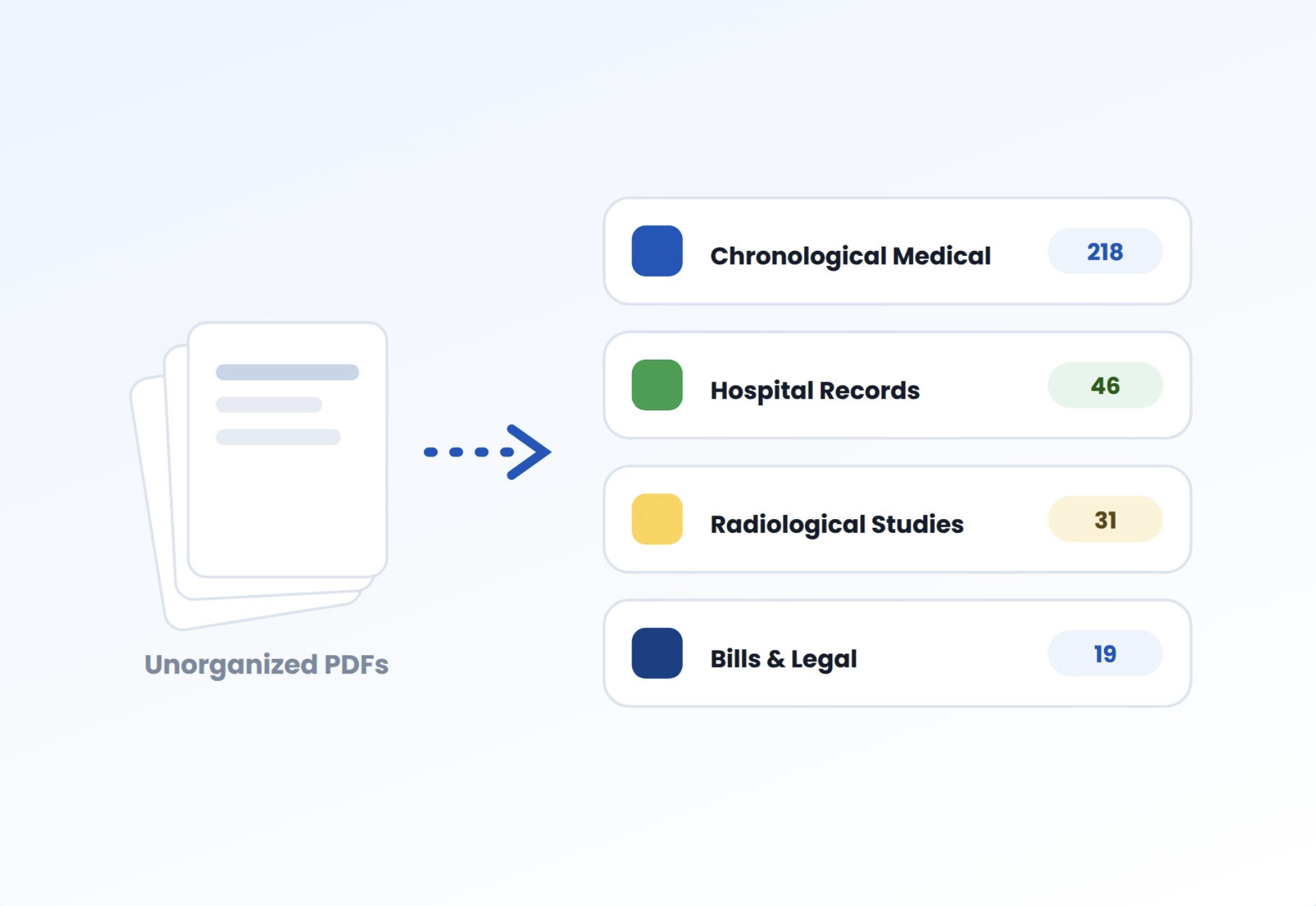
StreamCase sorts, categorizes, and de-duplicates every page as soon as it’s uploaded — then builds the treatment chronology automatically. You open a case that's already in order, not a thousand-page PDF in the order it happened to arrive.
HOW IT WORKS
Upload the Mess. Open an Organized Case.
No manual sorting, no wasted afternoon. Categorization and the chronology are built for you, developed alongside physicians with decades of IME experience.
01
Upload records of any size
Securely upload the full record set to a secure cloud environment. Scanned, faxed, handwritten, hundreds of megabytes — all of it, in one drop.
02
AI organizes and de-duplicates
Every document is automatically categorized, duplicates are detected and hidden, and full treatment chronology is assembled across every record type.
03
Read a case that's already in order
Open a clean, date-ordered case with gaps and inconsistencies visible at a glance. Move straight into the reasoning that actually requires your attention.
WHO WE ARE
Built at the Source, Not the Sidelines
Most medical chronology software is built by people who have never sat down with a ten-thousand page case file. They design for a workflow they've heard described, not one they've lived.
StreamCase started differently. Our co-founder is a board-certified orthopedic spinal surgeon who has performed thousands of IMEs, so the person who understood the pain points was the person building the fix. No product team translating requirements secondhand, no guessing at what an evaluator values or where the workflow actually breaks. Just a physician solving the exact problem he had, the way he needed it solved.
That's the difference between software built for the market and software built for you. One guesses. The other already knows.
CAPABILITIES
What “Organized” Actually Means
Each physician has full control of which document types are grouped together for their records review. They’re then categorized exactly how each individual examiners need them, not how they happened to be scanned.
-
Sorted by record type, provider, and date. No manual tabbing
Handles scanned, faxed, and handwritten pages, not just clean digital PDFs
-
The full treatment history, date-ordered across every provider and record type
Purpose-built for personal-injury and workers'-comp timelines where pre-existing degeneration has to be separated from the injury
-
Exact duplicates detected and hidden automatically — often hundreds of redundant pages per case
You read the record once, not the three times it was produced
-
Intuitive interface, no training required
Multi-page view modes for quickly moving through non pertinent records
Page level progress tracking so you know which documents you’ve already reviewed
Designed for how physicians actually read a medical-legal file, not a generic document viewer
The StreamCase Difference
Experience the Difference AI-Powered IME Software Makes
See firsthand how StreamCase can transform your practice efficiency. Request a personalized demo and discover why independent medical evaluators trust our physician-built platform.
Questions IME Physicians Ask
-
Outsourced chronologies come back on someone else's timeline, at a per-page cost, prepared by a non-physician you then have to check. StreamCase builds the chronology automatically the moment records land — in minutes, inside your own secured environment, with every entry traceable to its source page. You stay in control of the file.
-
Yes — large, multi-provider files are exactly what it's built for. There's no practical page ceiling, and bigger, messier files are where the de-duplication and auto-chronology save the most time.
-
Yes. Categorization and the chronology run on scanned, faxed, and handwritten pages via OCR, not just typed text — which is most of what actually shows up in a medical-legal file.
-
You don't prepare it — you upload the records and the chronology is assembled for you. You review the date-ordered history within the draft report tab, and everything links back to the source page.