

Case Search
Medical record review that finds any page in seconds.
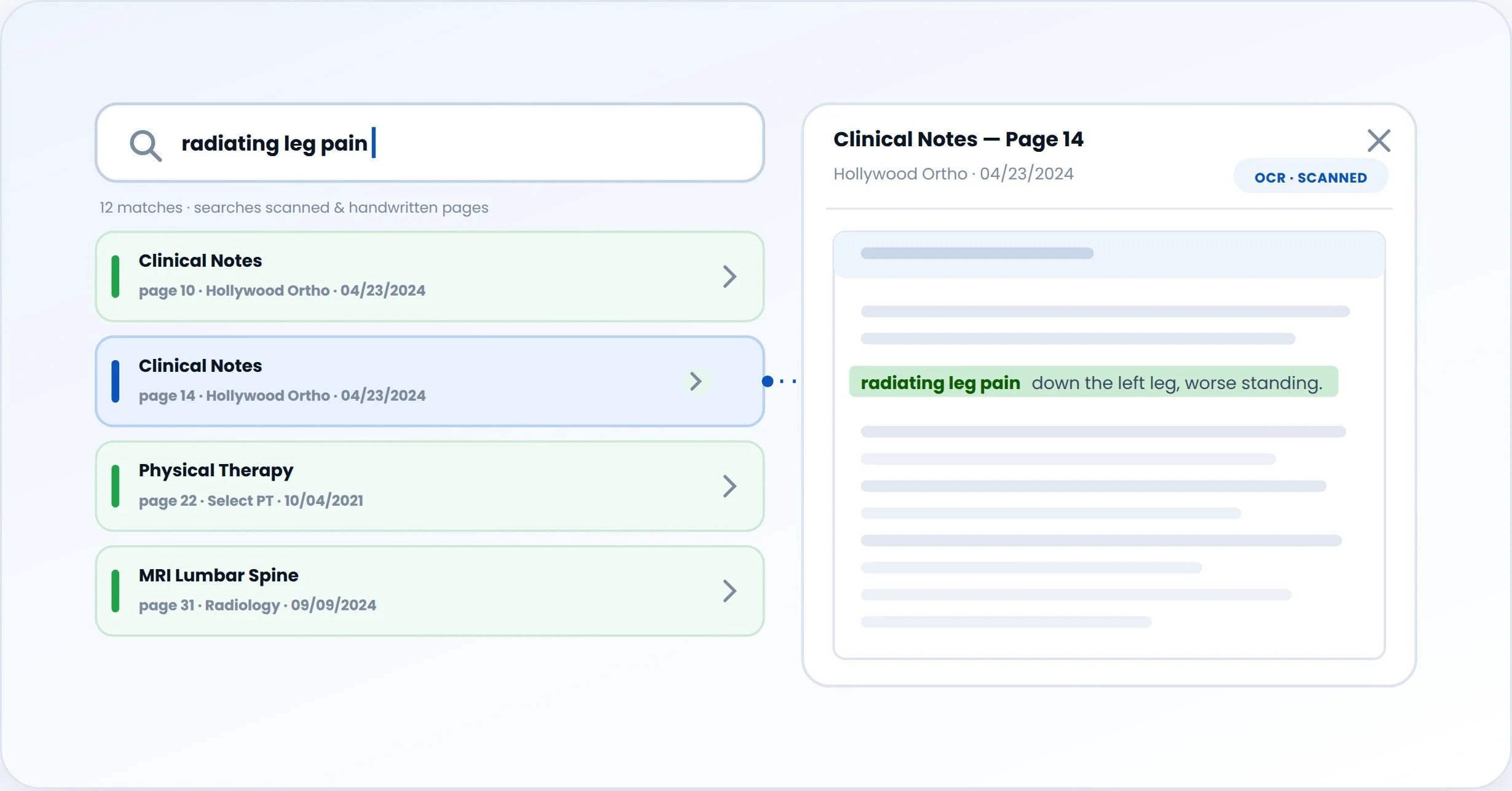
Full-text search across the entire case, including scanned and handwritten records via OCR. “Where was the first mention of radiating leg pain?” is answered instantly, with a jump straight to the source page in the organized case.
HOW IT WORKS
Ask a Question. Get the Page.
Case Search turns the entire record set into something you can query, including the pages other tools go blind on.
01
Search the whole record set
Search clinical notes, imaging, operative reports, legal file, and billing all from one place, not from one PDF at a time.
02
Including scanned and handwritten pages
OCR reads faxed, scanned, and handwritten records, so the pages most likely to hold the key fact are actually searchable.
03
Jump straight to the source
Every result links directly to its page in the organized, chronological case — you land on the fact in context, ready to use it.
THE PROBLEM
A Needle In A Two-Thousand-Page Haystack
The exam-prep question is always specific: when was radiating leg pain first documented? Is there a prior complaint to this shoulder? Which note mentions the pre-existing degeneration? The answer is a sentence, buried somewhere across a multi-provider file, often in a scanned or handwritten page a text search can't even see.
Ordinary PDF search fails on exactly the records that matter most: the faxed operative note, the handwritten therapy log, the imaging report scanned at an angle. So you read the whole file again to find one line, or you outsource the review and wait on someone else's summary.
Either way, the highest-value question in the case, does the accident explain the anatomy, is gated behind a page hunt.
Case Search closes that gap. Ask the question. Get the page.
CAPABILITIES
Built for The Exam-Prep Moment
This is medical record review done by search: fast, in-house, and traceable — not a stack of pages and not a wait on an outside vendor.
-
One query spans every document and record type in the file
Find the first mention of a symptom, a prior injury, a medication, a provider, in seconds
-
OCR covers scanned, faxed, and handwritten records, not just typed text
The faxed op note and the handwritten therapy log are finally findable
-
Jump straight from a hit to the source page inside the organized case
See the fact where it lives in the chronology, not as a stray snippet
-
Review stays in your secured environment and on your timeline
No handing PHI to an outside reviewer and waiting on their read
The StreamCase Difference
Experience the Difference AI-Powered IME Software Makes
See firsthand how StreamCase can transform your practice efficiency. Request a personalized demo and discover why independent medical evaluators trust our physician-built platform.
Questions IME Physicians Ask
-
Outsourcing sends PHI to a third party and returns someone else's summary on their schedule, at a per-page cost. Case Search keeps review in your own secured environment: you ask the question and get the source page in seconds, on your timeline, with full context.
-
Yes. OCR makes faxed, scanned, and handwritten pages searchable — which is most of a real medical-legal file. That's the whole point: the hard-to-read pages are usually where the key fact hides.
-
Every result links to its exact source page in the case, so you verify against the record itself. Nothing is asserted without a page you can open.