
A thousand-page case file can contain medical evidence, repeated records, billing, legal documents, and the paperwork that travels with all of it. Understanding that mix helps an IME physician plan the review and find the source of a fact without losing its context.
Across a large volume of cases, StreamCase found that 11% of all pages processed were duplicates. That observation is one part of understanding file composition; it does not describe the mix of record types in an individual orthopedic file.
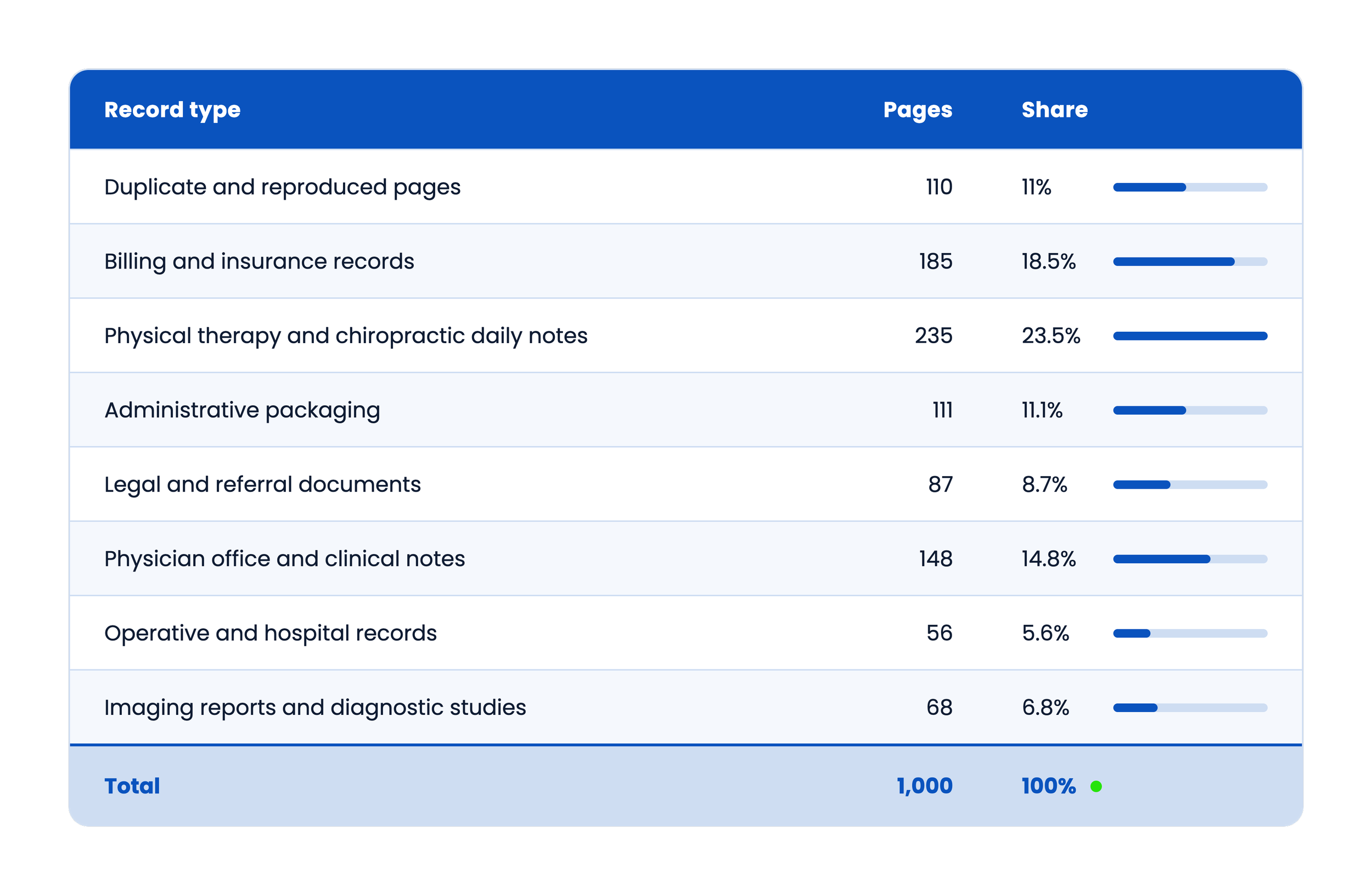
The example below applies that 11% rate to a constructed 1,000-page orthopedic IME file: 110 duplicate pages and 890 remaining pages.
The Page Mix
Physical therapy and chiropractic daily notes form the largest single category, followed by billing and insurance records. Physician notes, operative and hospital records, and imaging reports together make up about 27% of the file.
Duplicates and administrative packaging add another 22%. That’s more than a fifth of the file before any clinical record is read. Duplicates and administrative packaging add another 22%. That’s more than a fifth of the file before any clinical record is read.
Duplicate and Reproduced Pages
The same emergency department record can arrive from a hospital, in an attorney’s production, and again as an attachment to a prior evaluation. An MRI report may be appended to several specialists’ notes. Multiple copies increase the page count without necessarily adding new evidence. Similar-looking pages still need care: an added annotation, changed finding, or different visit date can make a page distinct.
Billing and Insurance Records
Billing ledgers, explanations of benefits, and insurance correspondence can help establish services, dates, and the course of care. Their relevance depends on the assignment, including whether utilization or treatment reasonableness is among the referral questions. Grouping them makes the file easier to navigate without treating them as disposable.
Physical Therapy and Chiropractic Daily Notes
These notes can be high volume and use repeated templates. The useful history includes initial deficits, response to treatment, changes in function, and discharge status. A chronology can make that progression easier to follow, but an individual session may document a change that deserves closer attention. A repeated template does not make a note a duplicate.
Administrative Packaging
Cover sheets, fax headers, certifications of records, custodian affidavits, authorizations, and blank pages add bulk. They may contain little treatment information, but some establish where records came from or help identify what was requested and produced. Keeping them identifiable preserves that context.
Legal and Referral Documents
The referral letter, deposition excerpts, incident reports, and first-report-of-injury forms help define the assignment and the history presented. Prior IME or QME reports can also appear in the file. These records may be short, but the questions they raise can shape the review of everything that follows.
Physician Office and Clinical Notes
The narrative spine of the treatment history: initial presentations, specialist consultations, follow-up visits, and the notes where symptoms first appear or change. Reading them in date order across providers makes it easier to compare accounts and follow the course of care.
Operative and Hospital Records
Operative reports, anesthesia records, implant logs, and postoperative checks describe different parts of an episode of care. The operative report can be important, but it belongs alongside the surrounding records rather than standing in for them.
Imaging Reports and Diagnostic Studies
X-ray, MRI, CT, and EMG/NCS reports can help the evaluator trace findings over time. Distinguish the report from the underlying images or study data, and note what was actually provided. Repeat studies and earlier findings may matter as much as the latest report.
Where the Answers Actually Live
Now overlay the referral questions. An orthopedic IME may address causation, apportionment, maximum medical improvement, impairment, work capacity, or treatment reasonableness. Each question gives the evaluator a way to organize the evidence:
Causation and apportionment may draw on the earliest documented presentation, the reported mechanism, prior complaints or injuries, imaging, and the subsequent course of care.
Maximum medical improvement and impairment may require operative and follow-up records, functional measurements, treatment response, and the applicable evaluation framework.
Work capacity may draw on documented restrictions over time, therapy findings, functional capacity evaluations when available, and the relevant job demands.
Treatment reasonableness may require tracing the course of care across clinical notes, therapy records, diagnostic studies, and billing.
These are starting points for locating evidence. A brief note elsewhere in the file may corroborate or challenge the apparent story. There is no fixed number of pages that determines an opinion, and a record-type label does not establish that a page is irrelevant.
Why This Makes Large Files Expensive to Read
The evidence is distributed. Records may arrive grouped by custodian or production date, with repeated documents and overlapping treatment periods. To follow one issue, the evaluator has to reconnect events across those groups.
An inventory by record type and a date-ordered timeline across providers make that work more manageable. They show where to begin, where accounts differ, and where a missing record may need follow-up. They also provide a route back to the source when a detail needs checking. The evaluator still decides what the assignment requires and whether the available record supports an opinion.
What to Do with This
Treat page count as a starting point. Look at duplicate volume, record types, treatment span, number of providers, legibility, and referral questions before estimating the work. Fewer pages do not automatically mean a simpler case.
Separate confirmed duplicates before the substantive review. Preserve access to the original records and source references. Do not treat similar templates or repeated language as proof that two pages are identical.
Build the timeline across providers. Use it to follow the treatment history, locate gaps, and compare accounts. Check the underlying records when chronology entries affect the opinion.
Make the file searchable. Search can help locate a symptom, procedure, provider, or prior injury. Check results against the source page, especially when OCR is reading scans or handwriting; a search with no result does not prove a fact is absent.
The Bottom Line
A thousand-page orthopedic file is a collection of different kinds of evidence, with different roles in the review. Duplicate removal addresses one part of the workload. Organizing the remaining records helps the evaluator follow the history, investigate inconsistencies, and support conclusions with traceable sources.
See your own file’s composition. StreamCase organizes records by type, provider, and date, detects and hides exact duplicates, and provides full-text search, including scanned records through OCR. It supports medical-legal record review; the physician remains responsible for reviewing the evidence and forming the opinion. Explore Case Organization and Case Search, or request a demo.